Source: https://bsima.wiki.fc2.com/wiki/%E5%A4%A2%E3%81%AE%E3%81%8B%E3%81%AA%E3%81%9F%E3%81%AB%EF%BC%97
https://web.archive.org/web/20220817104755/https://webronza.asahi.com/national/articles/2012120700007.html
2012.12.08
Beyond the Dream 7 - Report on the Sixth Grand Prix Event, the NHK Trophy (Part 2)
The Free Skate Where He Gave 120%
He had managed to get through the NHK Trophy short program in a way that was more than just satisfactory. In fact, his performance had come close to perfection.
All that remained was the free skate. Those close to Yuzuru Hanyu had entered the day of the free skate with something like a prayer in their hearts: they hoped he would relax and skate freely, without feeling the weight of pressure or responsibility.
To reiterate, many skaters regard the Grand Prix Series as a warm-up during the first half of the season. For example, when American skater Mirai Nagasu, who finished third, was asked about the mistakes she had made on a few jumps, she replied matter-of-factly:
“But if I skated perfectly here, I wouldn’t know what I should work on before the U.S. Championships!” (laughs)
Brian Orser, Hanyu's coach, was equally emphatic when asked what mattered most for Hanyu at this point.
“Of course, it’s about focusing on the Japanese Championships. It’s important for him to deliver two good performances, in both the short program and the free skate, at the upcoming Final, too. But I really want him to start focusing specifically on the Japanese Championships now.”
For every skater, the World Championships are the most important competition of the year. And for skaters from countries with deep fields of talent, such as Japan, the United States, and Russia, the national championships, such as the Japanese and U.S. Championships, which determine who will represent their countries at the World Championships, are also crucial. Their focus should remain firmly on these competitions. That is how elite skaters approach a season in which they compete in numerous events throughout the year. Yuzuru Hanyu undoubtedly understood this, too.
Nevertheless, he seemed to approach every single competition at 120 percent. This time in particular, it was a home event where he was receiving tremendous support and attracting intense attention. He was determined to show everyone what he could do and how much he had grown. He was also fully aware of the expectations of those watching him: “The boy who set a world record. Will he show us something amazing again?”
“It’s a competition at home, after all. I really felt like everyone was watching me...” (comment after the short program) “I managed to do that much in the short program. What on earth will I do next? I want to deliver a performance that lives up to everyone’s expectations.”
And so, in the free skate, too, he ended up giving 120 percent. He psyched himself up as if this were the biggest competition of the season, felt the nerves as if it were the biggest competition of the season, and poured everything he had into it as if it were the biggest competition of the season.
He opened with two quadruple jumps and landed the toe loop beautifully. Although he lost his balance on the Salchow, he managed to stay on his feet rather than fall. “I’ve done a lot of practice to be able to skate through the program from beginning to end as one complete piece.” His program allowed him to use his body beautifully in flowing, undulating movements. He performed each element of the difficult step sequence, which he was aiming to have rated Level 4, with meticulous care. His movements were still a little tentative, but he performed as though he were doing his utmost to communicate something to everyone watching.
One international judge described Hanyu's appeal at the time as being “like freshly picked green tea.”
“He may not yet have the deep flavor of fully matured tea. Its taste is a little sharp, and it has some distinctive qualities. Even so, its freshness, its indescribably vivid green aroma and color, are irresistibly appealing.”
While captivating the audience with his skating, he also successfully landed two Axels during the five-jump sequence in the second half, a section that was just as important and demanding as the quadruple jumps.
At this rate, his only major mistake would be the quadruple Salchow. Just as in the short program, everyone thought he would finish in a form that came as close to perfection as possible! But then he fell on his final jump, the triple Lutz. What’s more, during the first of his two consecutive spins, the combination spin, he became extremely unsteady and collapsed to the ice in another fall.
“At the end, I was so pathetic that I just started laughing!” (laughs) “I was exhausted. My body just wouldn’t move anymore.”
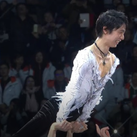
He looked back on the final moments of his performance with a slightly embarrassed smile. Although his lack of stamina was once again identified as an area needing considerable improvement, he still won by a comfortable margin over Daisuke Takahashi and Javier Fernández of Spain, both of whom had made numerous mistakes.
Although his performance had not been perfect, Hanyu finished the NHK Trophy having thoroughly excited and astonished the audience, earning thunderous applause.
“I know full well that I can’t maintain my stamina all the way through the second half. This time was actually better than usual. When my concentration starts to wander, as it did at Skate America, I lose even more stamina...”
As people were concerned, his lack of stamina was certainly one of his major challenges at the time. However, the problem of being unable to maintain his strength through the second half of the free skate, which had been pointed out repeatedly since 2010 and 2011, was not something that had remained entirely unchanged.
In Hanyu's case, it was apparently not simply a matter of insufficient stamina. Weakness in his respiratory system was also a contributing factor.
“Until now, he had been overusing the muscles in his upper body, especially those in his chest, causing them to become stiff and tense. By loosening those muscles with acupuncture, I think breathing has become considerably easier for him. Air can now enter his chest more easily, where everything had been so tense and rigid. This means he can manage David Wilson's free skate, too. He seems to be feeling the difference himself. He says things like, ‘Sensei, I can make it to the end now without getting exhausted!’” (laughs)
The person explaining this was massage therapist Tadashi Aoshima.
Through acupuncture treatments in Toronto, Hanyu was gradually developing the physical capacity to get through a four-and-a-half-minute free skate.
Even so, there was a reason he had once again shown signs of running out of breath in the second half, just as he had during the 2011–12 season. One was that this season’s free skate was a “trial by fire” of a program, requiring him to execute more complex step sequences and demonstrate more intricate skating skills. Another was that he had not yet mastered the pacing needed to skate through all four minutes and thirty seconds.
In practice, he could confidently say that, in the just under a month since Skate America, he had managed to skate through the increased amount of time he was spending on the ice. But in competition, he became excessively nervous without even fully realizing it, and his desire to live up to expectations was so great that he went all out from the very beginning, giving 120 percent.
Naturally, by the second half, he was so exhausted that his performance began to fall apart.
At this early stage of the season, the Grand Prix Series is best approached as a trial run, skating while observing one’s own condition. But this time, Hanyu was brimming with the determination to give it his all in front of his hometown audience. That was precisely why he had pushed himself too hard in the free skate.
By contrast, Daisuke Takahashi, who finished second, and Javier Fernández, who finished third, had both avoided overexerting themselves. Knowing that they did not need particularly high placements to qualify for the Final, they assessed their current condition and conserved their energy where necessary, putting together performances and results that were good enough to pass.
As for the quadruple jumps, Fernández had missed two of his three attempts, while Takahashi had missed one of his two. But this, too, was merely part of the preparation process for “being able to land my best jumps at the Olympics,” as Takahashi put it. They did not need to be jumping at the highest difficulty level right now. Both Takahashi and Fernández explained that they were adjusting their form with an eye toward peaking at this year’s World Championships and, further ahead, the Sochi Olympics.
These two veterans, well versed in how to manage a competitive season, would presumably raise their pace gradually as the second half of the season approached. Given their current condition, they were unlikely to regress from here. The same was probably true of Patrick Chan, who was competing in other events. “This isn’t the main event yet,” they maintained, emphasizing that “it’s important not to let yourself be swayed by the pace of other skaters.”
This brings to mind Shizuka Arakawa’s approach to the 2005–06 Olympic season. Already a World Champion at the time, she lost to Mao Asada, who was still a junior, during that year’s Grand Prix Series and failed even to qualify for the Grand Prix Final. Looking back on that experience, Arakawa said, “Seeing young skaters who had nothing to fear going all out from the beginning of the season was stimulating. But I tried not to let it disrupt my own pace.” Arakawa then timed her peak perfectly for the Turin Olympics and went on to win the gold medal.
Hanyu, who had competed at Skate America and then the NHK Trophy, had certainly not taken a particularly measured approach. Third place would have been enough to qualify for the Grand Prix Final. Nevertheless, he had declared his intention to win the NHK Trophy outright, saying, “I’m absolutely going to win. It would be frustrating to qualify because of someone else’s results. I have to make it to the Final on my own!” He delivered on that promise, winning the competition. But if he continued charging ahead at full speed through the Final and the Japanese Championships, would he not end up completely exhausted? This was precisely what concerned Coach Orser.
And yet, his attitude of “giving it his all every time” was also what made Hanyu so unmistakably himself at seventeen. His wholehearted, almost awkwardly unrestrained way of throwing himself into competition without holding anything back was refreshing, and perfectly befitting a fearless rising star. Among all the world’s leading skaters gathered around him, he was the only teenager.
Even looking at this year’s Grand Prix Final qualifiers, he stood out as exceptionally young among a field consisting entirely of skaters in their twenties, with the twenty-six-year-old Daisuke Takahashi the oldest. Someday, Hanyu would learn to compete with the sophistication and tactical skill of an adult. But before that day came, I want to watch closely and remember this determined, single-minded version of Yuzuru Hanyu, a skater we could only see at this stage of his life.
In any case, the NHK Trophy had placed far too great a burden on him to be called a home event without qualification. Having made it through the toughest challenge of his season so far, he had performed more than admirably.
“When it was over and I went back to my room alone, my stomach started hurting, or I’d get so worked up that I couldn’t sleep… All things considered, I realized I really had been nervous. I wanted to finish both the short program and the free skate with a smile, no matter what, so of course I ended up feeling nervous. It was the people in the arena who helped me control those nerves and gave me the push I needed. Thanks to them, I achieved my goal of finishing with a smile! The power of my hometown is limitless.”
“Seeing him skate happily in front of the people back home... That really made me happy, too,” said Coach Orser.
Surely, with this competition behind him, Hanyu had made it through the most mentally demanding experience he had faced so far. In the future, he would compete several more times for the World Championship title and even at the Olympics. But for him, there would probably never again be a situation as difficult as returning home in triumph to his local audience, especially in Miyagi.
Now comes the Grand Prix Final, the Japanese Championships, and then the World Championships in March. A seventeen-year-old charging ahead single-mindedly, carried along by sheer momentum, versus skaters in their twenties competing cleverly while maintaining their own pace. What results lay ahead for them?
Even if he runs out of breath, even if he ends up collapsing halfway through in a rather undignified fashion, many people would still watch closely as Yuzuru Hanyu tries to race through every moment at full speed.
By
yuzurujenn ·